
.png)


Mount Kilimanjaro Trekking Tour: The Definitive Guide to a Successful Summit
A successful summit of Uhuru Peak is not a matter of luck; it's an engineered outcome. It's the result of strategic route selection, superior acclimatisation protocols, and the unwavering discipline that comes from an expedition mindset. Forget the mass-market conveyor belt; this is your guide to joining a genuine Mount Kilimanjaro trekking tour, designed for those who seek a true physical challenge and the profound reward of standing on the roof of Africa.
This definitive guide cuts through the noise of generic travel advice. We will dissect the critical factors that separate a triumphant summit from a disappointing descent, focusing on the proven methodologies that transform a difficult trek into a life-defining achievement. Discover how to select the optimal route, understand the science of acclimatisation, and prepare your body and mind for the rigours of a high-altitude expedition.

Table of Contents
What is a Mount Kilimanjaro Trekking Tour?
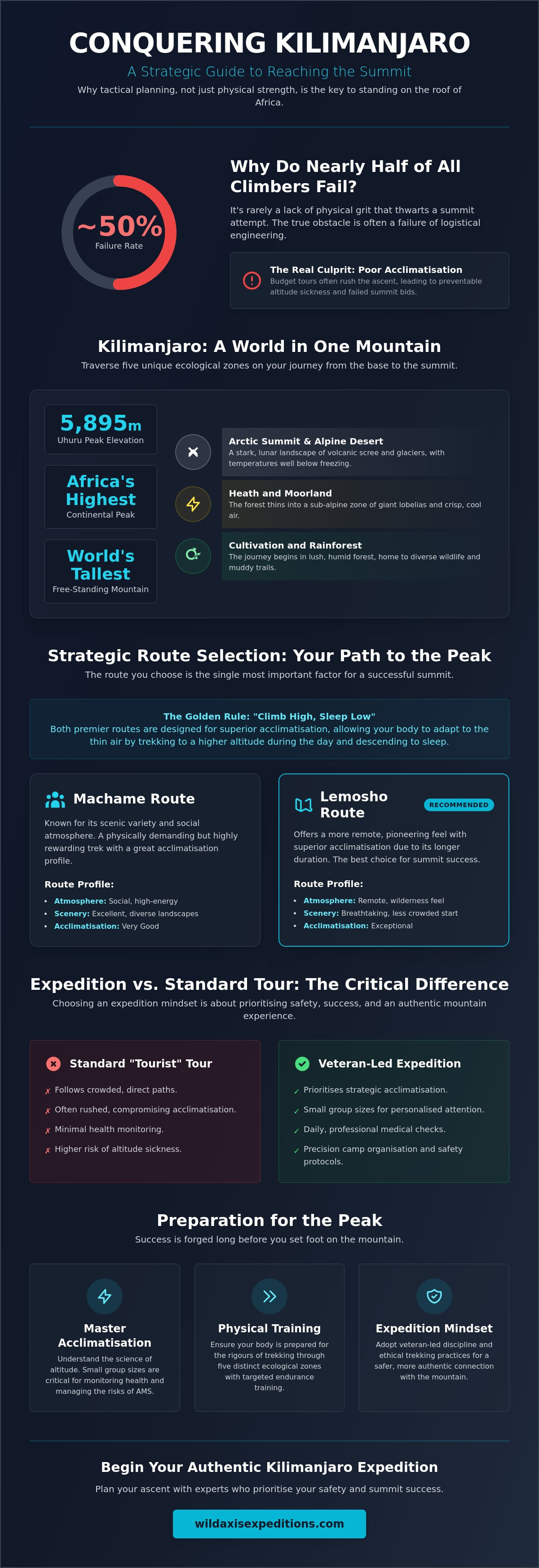
A Mount Kilimanjaro trekking tour is an organised expedition to the summit of Africa's highest mountain, Uhuru Peak, which stands at a formidable 5,895 metres (19,341 feet). As the world's tallest free-standing mountain, it presents a unique challenge: a trek that takes you through five distinct ecological zones, from humid tropical rainforest at its base to an arctic landscape at its summit. Unlike technical climbs such as Everest, Kilimanjaro is a 'walk-up' peak, meaning no ropes, harnesses, or mountaineering skills are required. However, this accessibility is deceptive. The trek demands significant cardiovascular endurance, mental resilience, and, most critically, a profound respect for the effects of high altitude. This is why a professionally managed expedition is not just a recommendation; it's a necessity for safety and success.
The Five Climate Zones of Kilimanjaro
The journey from the park gate to Uhuru Peak is a rapid ascent through vastly different worlds. Each zone presents its own unique environment and challenges, requiring you to adapt both physically and with your gear.
Cultivation and Rainforest (800m - 2,800m): Your trek begins in the lush, humid foothills, walking through farmland before entering a dense, tropical rainforest. Expect muddy trails, the sound of colobus monkeys, and vibrant, oversized flora.
Heath and Moorland (2,800m - 4,000m): As you climb higher, the forest gives way to a landscape of giant heather, hardy shrubs, and otherworldly giant lobelias and groundsels. The air becomes cooler and thinner, and you'll get your first expansive views of the mountain above and the plains below.
Alpine Desert and Arctic Summit (4,000m - 5,895m): The final push is a brutal, spectacular ascent through a high-altitude desert. Vegetation is sparse, replaced by volcanic scree and rock. This barren landscape eventually transitions into the permanent ice fields and glaciers of the arctic summit zone, where oxygen levels are roughly half of what they are at sea level.
Why Choose an Expedition Over a Standard Tour?
The distinction between a 'tour' and an 'expedition' is fundamental to your experience on Kilimanjaro. A tour often implies a passive, packaged holiday. An expedition, by contrast, is an active, objective-focused journey demanding preparation, discipline, and teamwork. Our approach is shaped by a veteran-owned ethos, which instils a level of planning, risk assessment, and operational excellence that is simply absent from mass-market operators. This philosophy, executed by our elite local guides, prioritises safety and success above all else. It's the difference between being a passenger on a crowded path and being a valued team member on a serious mountain objective, navigating the wilderness with purpose and expertise.
Strategic Route Selection: Machame vs Lemosho
Your choice of route is the single most important decision you will make in planning your Mount Kilimanjaro trekking tour. It directly impacts your acclimatisation schedule, the scenery you experience, the crowds you encounter, and ultimately, your probability of reaching the summit. Whilst numerous routes exist, serious expedition companies focus on those that offer the best balance of acclimatisation and wilderness experience. The two premier choices are the Machame and Lemosho routes. Both are designed around the critical 'Climb High, Sleep Low' principle, where each day involves trekking to a higher altitude before descending to a lower elevation to sleep. This process is the cornerstone of effective acclimatisation, allowing your body to adapt gradually to the thinning air.


The Machame Route: The Classic Challenge
Often called the 'Whisky Route' for its tougher, more demanding profile compared to the easier 'Coca-Cola' Marangu route, Machame is the most popular path for good reason. It offers a superb acclimatisation profile and a stunning variety of landscapes. Our 10-day itinerary is optimised for success, providing an extra day on the mountain that significantly increases your chances of a safe and successful summit. The route approaches from the south, passing through all five climate zones and featuring iconic landmarks like the volcanic plug of the Lava Tower and the thrilling, non-technical scramble up the Barranco Wall. Its popularity means it can be busy, but its excellent success rates make it a classic and reliable choice for well-prepared trekkers.
The Lemosho Route: Scenic Superiority
For those prioritising breathtaking scenery and a greater sense of wilderness, the Lemosho Route is unparalleled. It is widely considered the most beautiful approach to Uhuru Peak. Beginning on the quieter western slopes of the mountain, the first few days of the trek take you through pristine rainforest with a higher chance of spotting wildlife. Lemosho converges with the Machame route at the Shira Plateau, but its longer 11-day itinerary provides an additional day for acclimatisation. This gentler ascent profile makes it an excellent choice for those with less experience at high altitude or anyone who wants to maximise both their summit chances and their enjoyment of the mountain's remote beauty. The initial solitude and superior acclimatisation schedule give Lemosho a distinct advantage.
The Science of the Summit: Acclimatisation and Group Size
Reaching the summit of Kilimanjaro is a physiological battle, not just a physical one. At 5,895 metres, the effective oxygen level is less than 50% of what it is at sea level. Your body must adapt to this hypoxic environment, a process known as acclimatisation. When this process is rushed, trekkers risk developing Acute Mountain Sickness (AMS), a debilitating and potentially life-threatening condition. Symptoms range from headaches and nausea to more severe forms like High-Altitude Cerebral Edema (HACE) and High-Altitude Pulmonary Edema (HAPE). The key to avoiding AMS is a slow, steady ascent, which is why 'budget' 5 or 6-day treks have dangerously low success rates. The 'Pole Pole' (Swahili for 'Slowly, Slowly') philosophy isn't just a suggestion; it is a non-negotiable rule for a safe expedition.
Why Small Groups Dictate Success
Group size is a critical, often overlooked, factor in expedition safety and success. We operate with a strict maximum of 8 clients per expedition. This is not an arbitrary number; it is a strategic decision designed to maximise your chances of reaching the summit safely. In a small group, our expert local guides can provide individualised attention and continuous monitoring.
Personalised Health Checks: With a low guide-to-client ratio, your lead guide can conduct thorough daily health checks, monitoring for early signs of AMS using tools like a pulse oximeter. In a large group of 20 or more, subtle but critical symptoms can easily be missed.
Team Cohesion: A small, tight-knit team fosters a powerful psychological advantage. During the immense challenge of the summit push, the shared camaraderie and mutual support within a small group can be the difference between turning back and reaching your goal.
Flexibility and Pacing: A smaller group can move at a more consistent and appropriate pace for all members, avoiding the 'one pace fits all' problem of larger tours that can leave some exhausted and others frustrated.
Understand the crucial differences in our deep-dive article: Small Group vs Large Group Trekking.

The 'Tanzanian Double': Acclimatising on Mount Meru
For the ultimate acclimatisation advantage, consider tackling the 'Tanzanian Double': summiting nearby Mount Meru (4,566m) immediately before your Kilimanjaro trek. This 4-day 'warm-up' climb serves as a perfect pre-acclimatisation programme. By spending several days and nights above 3,500 metres, you allow your body to kickstart the physiological adaptations needed for Kilimanjaro's extreme altitude. Trekkers who climb Meru first arrive at the Kilimanjaro start gate already well-acclimatised, transforming their Kili experience from a struggle against altitude into a more enjoyable and confident journey to the summit. This strategy virtually guarantees a more comfortable and successful climb.
Engineer your success with this powerful acclimatisation strategy: Mt Meru Summit & Safari.
Preparation for the Peak: Gear, Fitness, and Mindset
Your preparation in the months leading up to your Mount Kilimanjaro trekking tour is just as important as your conduct on the mountain itself. Success is built on a foundation of three pillars: targeted physical fitness, appropriate high-quality gear, and a resilient expedition mindset. Neglecting any one of these can jeopardise your attempt.
The physical training should focus on building cardiovascular endurance and leg strength. The goal is to prepare your body for long days of walking uphill at a slow, steady pace. Equally important is the 'Expedition Mindset'—the mental fortitude to remain positive, patient, and resilient in the face of physical discomfort, cold temperatures, and fatigue. This psychological strength is often the final piece of the puzzle on the long, dark slog to the summit.
Trekking Fitness Training Plan
Your training should simulate the demands of the trek. Whilst gym-based cardio is beneficial, it cannot fully replace the specific conditioning required for mountain walking. The most effective preparation involves getting out into the hills.
Focus on 'Time on Feet': The best training is long-duration hill walking. Aim for consecutive days of 5-8 hour walks, ideally on varied, uneven terrain, to build endurance and strengthen your joints.
Train with a Weighted Pack: Get used to carrying a daypack weighing approximately 8-10kg. This replicates the load you'll carry on the mountain and ensures your back, shoulders, and core are conditioned.
Consistency is Key: Begin your dedicated training at least 3-6 months before your departure date, gradually increasing the duration and difficulty of your walks.
Essential Gear for the Arctic Zone
Packing for Kilimanjaro means preparing for five climate zones in one week. A layering system is essential, allowing you to add or remove clothing to manage your body temperature. Whilst your full kit list will be extensive, two items are absolutely critical for the cold of the summit night and cannot be compromised.
The Right Footwear: Your hiking boots are your most important investment. They must be well-worn, waterproof, and provide excellent ankle support. Blisters or foot pain can end a trek prematurely.
Summit Layering System: For the final ascent, you will need a high-quality down jacket, thermal base layers, fleece mid-layers, and windproof outer shells for both your torso and legs. A 4-season sleeping bag is also non-negotiable for staying warm and recovering properly at high-altitude camps.
Finally, ensure you have comprehensive travel insurance that specifically covers high-altitude trekking up to 6,000 metres. Standard policies will not cover you, and adequate medical and evacuation coverage is mandatory.
Find out more about essential coverage: Travel Insurance.
The Wild Axis Difference: Veteran-Owned Kilimanjaro Expeditions
Choosing your operator is choosing your philosophy. We are a veteran-owned UK company, and this heritage informs everything we do. It instils a culture of meticulous planning, risk management, and unflinching discipline that is core to our operational DNA. We don't sell holidays; we organise and facilitate serious expeditions. Our commitment is to provide an authentic, small-group experience that stands as the antidote to mass-market tourism. When you join our team, you are not just booking a trip; you are committing to an objective alongside like-minded adventurers who value challenge, safety, and genuine wilderness immersion.
Expert Local Guides and Safety Standards
Our expeditions are successful because of the synergy between our company's exacting standards and the unparalleled expertise of our local Tanzanian guides. We partner with the best crews on the mountain—highly trained professionals with years of experience, certified in wilderness first aid and high-altitude physiology. They are the heart and soul of the expedition. Our safety protocols are rigorous and non-negotiable. Every team carries emergency oxygen, a comprehensive medical kit, and a pulse oximeter for daily health monitoring. We have robust evacuation plans in place, ensuring that in the unlikely event of an emergency, you are in the safest possible hands.
Our approach to high-altitude challenges extends to other iconic peaks. See how we tackle Morocco's giant: Mastering the Mount Toubkal Winter Climb.
Your Next Step to the Roof of Africa
The journey to Uhuru Peak begins with a single, decisive step. Choosing between the classic challenge of the Machame route or the scenic superiority of the Lemosho route is your first strategic decision. As an expert-led UK adventure company, we handle the complex logistics, allowing you to focus on your preparation. We are now taking bookings for our 2026 expeditions, offering you the chance to join a small, dedicated team on the adventure of a lifetime.

Take your place on the mountain.
Explore our upcoming Kilimanjaro expeditions.
Frequently Asked Questions
How hard is it to climb Mount Kilimanjaro for a beginner?
For a beginner with a strong level of fitness, Kilimanjaro is very achievable. It is a non-technical trek, but the primary challenges are the high altitude and the long daily distances. Consistent physical training focused on cardiovascular endurance and leg strength is essential.
What is the best month for a Mount Kilimanjaro trekking tour?
The best times to climb are during the dry seasons: January to March and June to October. These months offer the clearest skies and the highest probability of good weather on the summit. April, May, and November are the wettest months and are best avoided.
Do I need technical mountaineering gear for Kilimanjaro?
No, you do not need any technical gear like ropes, ice axes, or crampons. The route is a walking path all the way to the summit. However, you do need high-quality trekking gear, including broken-in hiking boots, a layering system for extreme cold, and trekking poles.
Which Kilimanjaro route has the highest success rate?
Longer routes have significantly higher success rates due to better acclimatisation. The 8-day Lemosho and 7-day Machame routes consistently boast success rates well over 90%, whereas shorter 5 or 6-day routes can have rates as low as 50-60%.
How much does a Kilimanjaro trekking tour cost on average?
Costs vary widely, but you should be wary of cheap operators. A reputable, safe, and ethically run 7-8 day trek will typically cost between £1500 and £4,000. This price reflects fair wages for porters and guides, park fees, quality food, and essential safety equipment.
Can I climb Kilimanjaro solo or do I need a guide?
It is illegal to climb Kilimanjaro without a licensed guide. This is a regulation set by the Kilimanjaro National Park Authority to ensure trekker safety and provide employment for local communities. All trekkers must be part of an organised group.
What happens if I get altitude sickness on the mountain?
If you develop mild AMS, your guide will monitor you closely and may treat symptoms with rest and hydration. If symptoms worsen, the only cure is immediate descent. Your guide is trained to recognise serious AMS and will make the final call to descend for your safety.
How many miles do you walk a day on Kilimanjaro?
The daily distance varies by route and itinerary, but you can expect to walk between 6 to 12 kilometres (4 to 7 miles) per day. The summit day is the longest and most strenuous, often involving 12-16 hours of trekking both up and down.


Comments