
.png)


Small Group vs Large Group Trekking: Which Is Best for Your Expedition?
You’re standing at a crossroads, not on a dusty trail, but in the planning stage of a life-defining expedition. Before you are two distinct paths. One is a wide, well-trodden route bustling with a large group of fellow trekkers, promising camaraderie and a lower price tag. The other is a narrower, more focused trail, designed for a small, agile team, promising intimacy and precision. The choice you make here, between small group and large group trekking, will define everything that follows: your pace, your safety, your connection to the wild, and ultimately, your chances of reaching the summit.
This isn’t merely about social preference; it’s about operational strategy. On a high-altitude expedition to places like Kilimanjaro or the Atlas Mountains, group size is a critical safety feature. It dictates how your team manages acclimatisation, responds to emergencies, and interacts with the fragile environments you’ve come to explore. Forget the tourist mindset. It’s time to adopt the expedition mindset, where every decision, starting with how many people stand beside you, is a calculated step toward success.

Table of Contents
The Group Size Dilemma: Why Your Choice Defines the Expedition
In the world of trekking, ‘group size’ is the operating system for your entire journey. It’s the invisible framework that controls the pace, the guide-to-client ratio, the logistical flow, and the very culture of the expedition. A large group operates like a tour bus, moving at the pace of the collective, with a fixed itinerary and a broader, less personal focus. A small group functions like a special forces unit: agile, adaptable, and built around the specific capabilities of its members.
Let’s put some numbers on it:
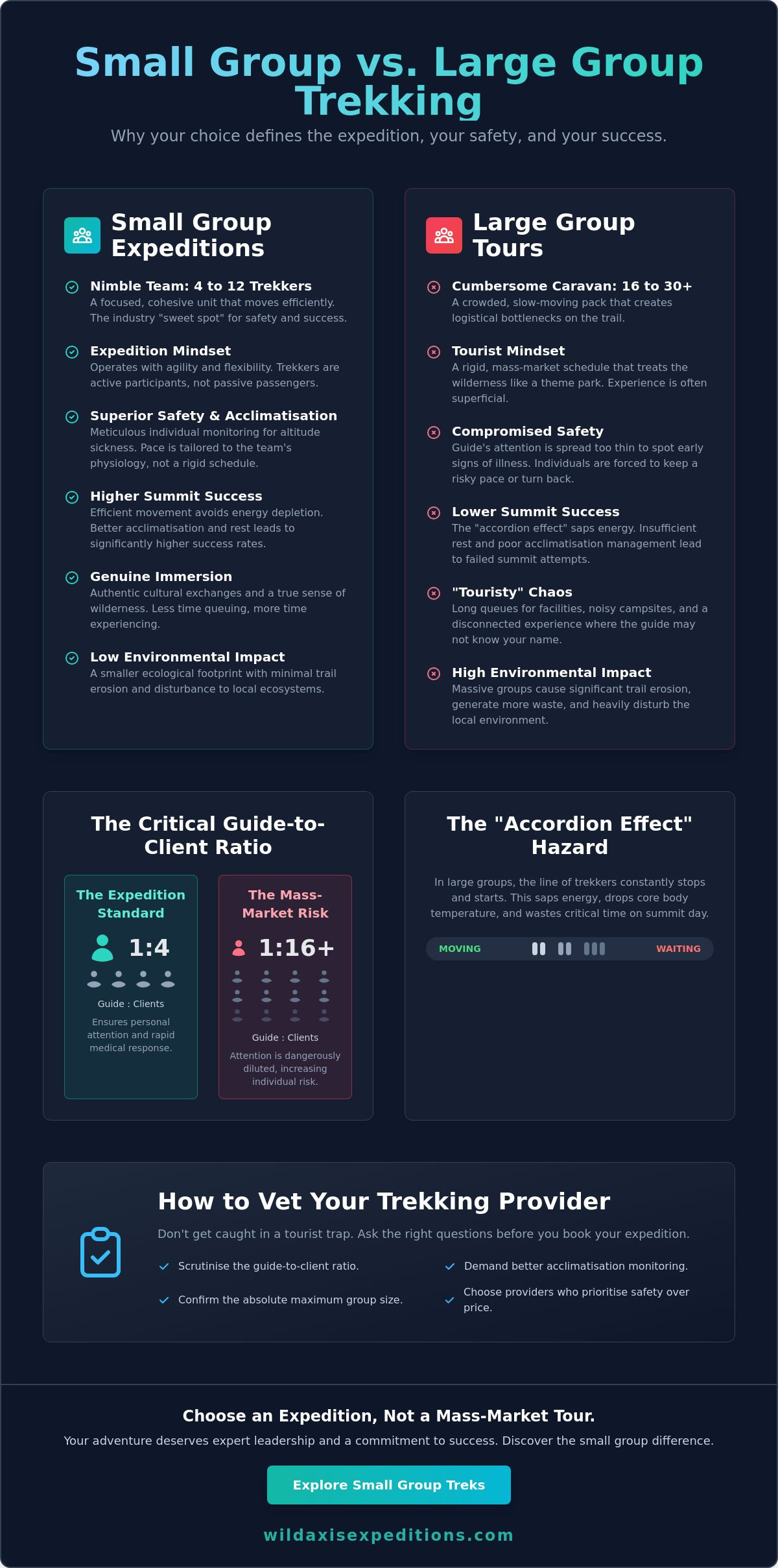
Large Group Trekking: Typically involves 16 to 30+ trekkers. These are often run by large-scale operators focused on volume. The primary appeal is a lower per-person cost, achieved through economies of scale.
Small Group Trekking: Generally refers to groups of 4 to 12. However, for truly remote and challenging expeditions, the definition tightens. At Wild Axis, we cap our groups at a maximum of 8 people (and run with as few as 2) because we believe this is the threshold where true team cohesion and uncompromising safety can be guaranteed.
The decision often hinges on cost, but this can be a misleading metric. The sticker price of a large group tour rarely tells the full story of your expedition experience.
What Constitutes a Small Group Expedition?
A true small-group expedition is defined by more than just a number. It’s a philosophy built around personalised attention and adaptability. In remote regions like the High Atlas Mountains of Morocco or the challenging trails of Kilimanjaro, this philosophy becomes a lifeline. The industry 'sweet spot' for safety is often cited as a 1:4 guide-to-client ratio. In a group of 8, this means two expert guides are entirely focused on your team’s wellbeing, constantly monitoring for signs of fatigue or altitude sickness.
This ratio allows for a level of individual care that is impossible in a crowd. As the group size scales, so does the support staff—porters, cooks, and camp crew. But whilst a large operation can feel like a moving village, a small one remains an intimate and efficient unit, able to move with purpose and minimal disruption.
The 'Hidden' Costs of Budget Large-Group Tours
The appeal of a lower upfront cost for a large-group tour can be powerful, but it often conceals compromises that can cost you dearly in the long run. When operators focus on filling seats, quality can become a secondary concern.
Compromised Safety: Lower costs can translate to older equipment, less experienced guides, or stretched guide-to-client ratios, especially on crucial summit nights.
Rigid Itineraries: A large group cannot easily adapt. If you or a few others are struggling with acclimatisation, the schedule will not wait. The group must press on, increasing the risk of altitude sickness and failed summit attempts.
The Price of Failure: What is the value of a 'cheaper' trip if it ends in you being forced to turn back? A failed summit attempt means you’ve spent thousands of pounds and a week of your life for a compromised experience. The higher success rates of well-managed small groups often make them the more valuable investment.

Speed, Safety, and Success: The Mechanics of Small Groups
On a high-altitude mountain, efficiency is safety. Wasted time means wasted energy and increased exposure to the elements. This is where the mechanical advantages of a small group become undeniable. A team of eight can organise gear, break camp, and start trekking far more quickly than a group of twenty. You’ll spend less time queuing for meals or latrines and more time focusing on the climb.
This agility is most critical when conditions are toughest. On summit night, when temperatures plummet and every step is a battle, a small group stays together, moves cohesively, and generates a shared warmth and morale. A large, strung-out group is harder to manage, and individuals are more likely to get cold and discouraged.
Most importantly, a small group allows a lead guide to maintain constant, direct oversight. They know each trekker’s name, their normal pace, and their typical behaviour. This familiarity makes it profoundly easier to spot the early, often silent, signs of Acute Mountain Sickness (AMS), such as uncharacteristic quietness or a subtle loss of coordination.
Acclimatisation: The Small Group Advantage
The single most important factor for summit success at high altitude is acclimatisation. The golden rule is 'pole pole'—a Swahili term meaning 'slowly, slowly'. It’s a philosophy that is easy to say but difficult for large groups to practise effectively.
A large group’s pace is inevitably an awkward average, too slow for the fittest and dangerously fast for those struggling. In a small group, the guides can tailor the daily ascent and overall pace to the actual condition of the team. If someone needs a slower day to adjust, the entire group can adapt without jeopardising the schedule. This flexibility is the cornerstone of successful acclimatisation and is a key reason why well-led small groups consistently achieve higher summit success rates on peaks like Mount Kilimanjaro. Guides can perform daily health checks, monitor oxygen saturation levels, and make informed decisions based on individuals, not an unwieldy crowd.
Crisis Management in Remote Wilderness
No one plans for an emergency, but expedition leaders must. In a remote environment, a medical issue can escalate quickly. The logistics of managing a crisis are exponentially more complex in a large group. Imagine a trekker needing a stretcher evacuation from 4,000 metres. In a small group, one guide can stay with the patient and coordinate the evacuation with porters, whilst the other guide manages the rest of the small, cohesive team.
In a large group, the lead guide’s attention is split between the casualty and a crowd of 20 other clients. Team morale can plummet as the remaining trekkers are left feeling anxious and unmanaged. In a small group, the bonds of trust are stronger. The team can rally together, support the guides, and maintain composure, ensuring that a single incident doesn't derail the entire expedition for everyone else.
Beyond the Trail: Environmental Impact and
Cultural Immersion
Your choice of group size has consequences that extend far beyond your own experience. It directly impacts the fragile ecosystems and remote cultures you travel to see. Every trekker leaves a footprint, but the collective weight of a large group can be devastating.
Think of the difference:
Ecological Footprint: A group of 30, with all its support staff, creates a 'tent city' at every camp. This leads to significant soil compaction, erosion on trails, and strain on local water sources. An 8-person team has a footprint that is orders of magnitude smaller.
Noise and Wildlife: The constant chatter and movement of a large group shatters the profound silence of the wilderness. This noise pollution not only ruins the sense of solitude for you but also scares away local wildlife, disrupting natural behaviours.
Waste Management: The logistical challenge of managing sanitation and carrying out all waste for 30+ people in a 'Leave No Trace' environment is immense. Smaller groups have a far greater capacity for maintaining strict environmental discipline.
The 'Leave No Trace' Reality
The seven principles of Leave No Trace are the ethical backbone of responsible trekking. For a small, dedicated group, these principles are easy to embody. A guide can personally ensure that every piece of litter is packed out and that campsite impact is minimised. In a large group, it’s far easier for standards to slip. The sheer volume of people makes it difficult to monitor everyone's behaviour, increasing the risk of water source contamination and trail degradation in high-traffic areas like the popular routes on Kilimanjaro.
Authentic Cultural Exchange
One of the most rewarding parts of any expedition is the connection with local people. This is where small groups offer an experience that large groups simply cannot replicate. A team of eight can be respectfully welcomed into a Berber family’s home in the Atlas Mountains for a glass of mint tea. A group of thirty can only be processed as tourists and offered a staged 'cultural show'.
In a small group, you have the space and time to have genuine conversations with your local guides and porters, learning about their lives, families, and perspectives. You become a welcome guest, not an overwhelming presence. This allows you to support local economies in a sustainable way that enriches the community without straining its social fabric.
Avoiding the 'Tourist Trap': How to Vet Your Trekking Provider
Armed with this knowledge, you can now assess trekking companies with a more critical eye. The slickest website or lowest price means nothing if the on-the-ground experience is compromised. It’s your responsibility to look past the marketing and ask the hard questions.
Find the Fine Print: Look for a clear, unambiguous statement on maximum group size. If it’s not prominently displayed, consider it a red flag.
Question the Ratios: Ask specifically about the guide-to-client ratio for the trek, and especially for summit night. Don't accept vague answers.
Beware 'Guaranteed Departures': This is a common lure used by large operators. It often means they will merge multiple small bookings into one massive group at the last minute to ensure the trip is profitable. Your intimate 8-person trek could suddenly become a 20-person crowd at the airport.
Leader vs. Guide: Understand the difference between a 'tour leader' (often a Westerner focused on client entertainment) and a qualified 'expedition guide' (a local expert with deep knowledge of the terrain, climate, and emergency procedures).

The 'Guaranteed Departure' Pitfall
Booking with a specialist company that prioritises the experience over volume is crucial. These companies would rather run a trip with a smaller group or postpone it than compromise their standards by cramming people together. Before you commit, ask the operator directly: "Under what circumstances would my group be merged with another?" Their answer will tell you everything you need to know about their priorities.
Evaluating Guide Expertise
Your guide is your most important safety asset. The best guides are almost always local experts who have spent their entire lives on the mountains they lead. Their intuitive understanding of the weather patterns and trail conditions is something that cannot be learned from a textbook. When vetting a company, look for one that invests in and empowers its local teams. Ask about their safety records, their emergency protocols, and ensure they carry comprehensive travel insurance and require it from their clients.
Our Standard: Why We Cap Our Groups at 8
Our entire operational philosophy is built on the undeniable advantages of small-group expeditions. We are not a mass-market tour operator; we are specialists who curate challenging, authentic wilderness experiences. For us, capping our groups at a maximum of 8 trekkers is not a marketing gimmick—it is a fundamental commitment to your success and safety.
Built for Success: Our group sizes are deliberately engineered to maximise acclimatisation flexibility and summit success rates on challenging objectives like a Mount Toubkal winter climb.
The Veteran-Owned Framework: Wild Axis is veteran-owned. This background informs our entire approach. Every expedition is built on a foundation of military-grade planning, meticulous risk assessment, and disciplined operational procedure.
Local Guide Expertise: We execute this precise planning by partnering with the most experienced and respected local guides in each region. This combination gives you the best of both worlds: a framework of uncompromising safety standards and the unparalleled, on-the-ground wisdom of a true mountain expert.
The Path Less Travelled: We select our routes, from Montenegro to Laos, not just for their beauty but for their ability to offer a genuine sense of solitude and discovery, an experience that is only possible with a small, low-impact team.
Veteran-Informed Precision
Our military background provides the blueprint for how we run expeditions. The 'no man left behind' ethos is not just a phrase; it's how we manage acclimatisation. We watch over our team with vigilance, ensuring the group moves as a cohesive unit where every member is supported. Our operational framework ensures that our elite local guides have the structure and resources they need to lead small, effective teams in challenging and unpredictable environments.
Your Next Step into the Wild
The choice is clear. If you seek a genuine connection with the wilderness, a higher chance of summit success, and an uncompromising approach to safety, the path of the small group is the only one to take. It’s about choosing an expedition over a tour, connection over crowds, and precision over profit. It’s about choosing to be a member of a team, not just a passenger.
Don't compromise on the experience of a lifetime. Choose the path less travelled.


Comments