
.png)


Mastering the Mount Toubkal Winter Climb: The Ultimate Mountaineer’s Guide
Updated: Jun 18
What if the most accessible gateway to high-altitude mountaineering isn't in the Alps, but amongst the snow-choked ridges of the High Atlas? You've likely conquered summer trails and now crave the bite of winter air, yet the thought of wielding an ice axe or strapping on crampons at 4,167 metres feels like a daunting leap into the unknown. It’s natural to feel a flicker of anxiety about managing sub-zero temperatures and the thin air of North Africa's highest peak. We understand that the transition from trekking to technical climbing requires more than just grit; it requires precision and professional preparation.
This guide will strip away the uncertainty, providing you with a roadmap to a successful Mount Toubkal winter climb. You'll discover everything you need to know about summiting Jebel Toubkal safely, from essential technical gear requirements to expert-led training strategies. We’ll also cover the logistical nuances, including the mandatory guide regulations and how to achieve authentic cultural immersion in the Berber villages of the High Atlas. Prepare to trade the ordinary for the extraordinary as we brief you on the skills needed to master the mountain and return home with a new level of mountaineering confidence.

Key Takeaways
Learn why the November to April window transforms the Atlas Mountains into a world-class Alpine training ground for those seeking a true summit challenge.
Identify the specific technical requirements for a Mount Toubkal winter climb, including why good-quality boots and crampons are non-negotiable for safety.
Understand the critical differences between summer trekking and winter mountaineering, focusing on how to manage specific hazards like black ice and avalanche risks.
Access a 12-week functional fitness strategy designed to prepare your body for the rigours of high-altitude weighted carries and steep snow ascents.
Discover how our expeditions and small-group dynamics mitigate risk and increase your chances of standing on the roof of North Africa.
Table of Contents
Conquering the Roof of North Africa: Why a Mount Toubkal Winter Climb is the Ultimate Challenge
From Trekking to Mountaineering: Essential Winter Skills and Technical Equipment
Winter vs Summer: Evaluating the Difficulty and Environmental Hazards
Preparation Strategy: Training Your Body and Mind for the Atlas Winter
The Wild Axis Difference: Expert-Led Expeditions to the Summit
Conquering the Roof of North Africa: Why a Mount Toubkal Winter Climb is the Ultimate Challenge
Standing atop Mount Toubkal in July is a feat of endurance; standing there in January is a feat of mountaineering. This 4,167-metre peak is the highest point in the Maghreb and the entire Arab world. Whilst summer trekkers contend with loose scree and heat, those undertaking a Mount Toubkal winter climb face a brutal, beautiful Alpine environment. Between November and April, the High Atlas sheds its dusty orange skin and dons a mantle of ice and snow. This isn't just a hike with a heavier coat. It's a significant step up that demands respect for the elements and a shift in mindset. The psychological reward of conquering the roof of North Africa in these conditions is immense, offering a sense of isolation and achievement that the summer crowds never experience.
The 4,167m Objective: Beyond the Summer Path
The transition from summer trekking to winter mountaineering is defined by the topography. The standard routes, once defined by winding paths of shifting shale, are buried under metres of snow. You aren't just walking anymore; you're moving on snow and ice. This shift offers a far more authentic wilderness experience. The landscape is transformed into a stark, high-altitude desert of white. Your base of operations is the Neltner Refuge, also known as the Toubkal Refuge. Sitting at 3,207 metres, this stone sanctuary is where the real work begins. It’s here you’ll lace up your boots, check your crampons, and prepare for the final 1,000-metre push into the thin air. The refuge provides the essential staging ground for the final assault, offering a communal space to brief the team before the dawn start.
The Seasonal Window: When to Plan Your Expedition
Timing is everything. The winter season officially runs from November to April, but the conditions vary wildly across these months. In Marrakech, you might enjoy a mild 20°C, but on the summit, temperatures frequently plummet to -15°C or lower when wind chill is factored in. You must account for the "Chergui." This dry, often violent easterly wind can turn a clear day into a technical challenge in minutes. Daylight is your most precious resource. With fewer hours of sun than in the summer months, your summit day logistics must be disciplined. We start in the pre-dawn darkness to ensure we're off the exposed ridges before the afternoon weather patterns shift. It’s a high-stakes game of preparation and timing that makes a Mount Toubkal winter climb so uniquely rewarding for the modern adventurer.
From Trekking to Mountaineering: Essential Winter Skills and Technical Equipment
Many trekkers arrive in Imlil expecting a steep walk, but a Mount Toubkal winter climb demands a fundamental shift in how you move. You are no longer navigating dirt paths; you are engaging with a medium where friction is earned, not given. This transition from walking to "moving on snow and ice" requires technical interfaces between your body and the mountain. The mountain doesn't care about your intentions; it only responds to your preparation. Joining a structured Mount Toubkal Winter expedition ensures you have the right kit and the training to safely enjoy the mountains.
For winter ascents, we recommend warm B1 or B2-rated mountaineering boots. These provide the insulation, support, and stability needed for cold mountain conditions while remaining compatible with the C1 crampons we supply. Unlike lightweight trekking footwear, winter boots offer greater confidence on snow-covered terrain and help maintain comfort during long days on the mountain. Our C1 crampons provide the traction required for the conditions typically encountered on Toubkal when paired with suitable boots, while the ice axe serves as an essential safety tool, providing additional stability on steeper ground and an important means of self-arrest should you slip.
Mastering the Crampon and Ice Axe
Step 1: Fitting: Ensure your crampons are adjusted to your boot length with no overhang. Loose straps lead to "balling," where snow cakes under the boot, stripping away your grip.
Step 2: Flat-footing: Use the French technique on moderate slopes. Keep all crampon points in contact with the ice to maximise surface area and stability.
Step 3: Axe Positioning: Always hold the axe in your uphill hand. This keeps your centre of gravity towards the mountain and provides an immediate anchor point.
Step 4: Self-Arrest: If you fall, you must immediately roll onto your stomach and drive the axe pick into the snow. It’s a violent, deliberate action that requires practice to become instinctive.
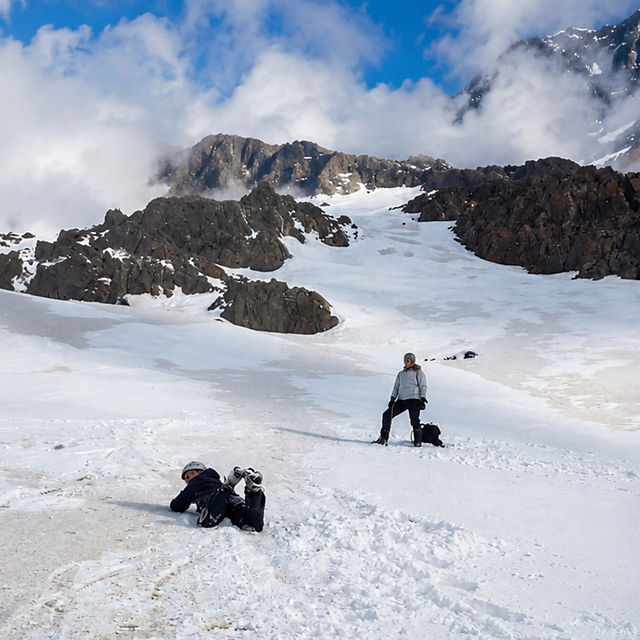


Cold Weather Management and Layering
In the High Atlas, moisture is the enemy. If you sweat through your clothes during a steep ascent, that dampness will freeze the moment you stop. We use a disciplined "Base, Mid, Shell" system. A high-wicking base layer moves sweat away from the skin, whilst a down or synthetic mid-layer traps heat. Your outer shell must be a fully waterproof and windproof fortress to deflect the cold winds. Don't neglect your extremities. A modular glove system, featuring a thin liner for dexterity and a heavy waterproof overglove for the summit push, is essential for preventing frostnip at 4,000 metres.
Winter vs Summer: Evaluating the Difficulty and Environmental Hazards
Is a Mount Toubkal winter climb simply a colder version of the summer trek? Many hikers assume the only difference is a heavier jacket, but the reality is a fundamental shift in the risk profile. Whilst the summer route is a gruelling slog over loose scree, winter introduces objective hazards that fitness alone cannot overcome. The most common objection we hear is that winter mountaineering is "too dangerous" for a regular hiker. It isn't. However, it is less forgiving. In summer, a slip usually results in a scraped knee; in winter, a slip on a frozen slope without the correct arrest technique can be catastrophic. We move from a world of friction to a world of slides, requiring a disciplined approach to every step.
The cold also complicates acclimatisation. At 4,000 metres, the air is significantly drier and thinner. In winter, your body works twice as hard to maintain core temperature, which can mask or accelerate the symptoms of altitude sickness. Dehydration is a silent threat; you often don't feel thirsty in sub-zero winds, yet your respiratory water loss is immense. Managing these environmental stressors whilst navigating technical terrain is what elevates this from a hike to a true mountaineering expedition. It requires a methodical pace and a constant self-assessment of your physical state.
Comparing the Seasons: A Statistical Look
Success Rates: Summer success rates often exceed 90%. In winter, this drops significantly, not because of physical failure, but because weather windows can slam shut. We respect the mountain's timeline, not our own.
Pack Weights: Expect your pack to weigh 4-5kg more than in summer. Technical hardware, extra thermal layers, and more substantial emergency kit add up quickly.
Vertical Pace: Kicking steps into fresh snow or traversing ice is energy-intensive. Your vertical gain per hour will likely be 30% slower than on a clear summer trail.
Assessing the Risk Profile
Safety on Jebel Toubkal is now highly regulated. Since 2019, it has been a legal requirement to be accompanied by a certified local guide. You will encounter checkpoints in villages like Aroumd where permits and guides are verified. This regulation has professionalised the industry and ensured that snow stability is assessed by those who live on the slopes. Most "broken leg" scenarios reported in the High Atlas aren't due to freak accidents; they are almost always the result of ill-equipped trekkers attempting to cross black ice in standard hiking boots. Professional guides use the Imlil check-in system and local mountain rescue networks to monitor conditions, ensuring that we only push for the summit when the risk is managed and the snowpack is stable.
Preparation Strategy: Training Your Body and Mind for the Atlas Winter
Success on the mountain is bought in the months before you land in Marrakesh. A Mount Toubkal winter climb isn't a weekend jaunt; it’s a physical commitment that requires a structured 12-week functional fitness programme. You aren't just training for the ascent. You’re training to manage a heavier pack, technical hardware, and the energy-sapping effects of sub-zero temperatures. We prioritise weighted carries in our training regimes. Start with a 5kg pack and gradually increase to 12kg over three months. This builds the specific postural endurance needed to carry your winter kit without compromising your balance on icy ridges.
Nutrition and hydration strategies must also shift for sub-zero environments. Your body burns significantly more calories just to stay warm. We recommend high-density, easily accessible snacks that you can eat without removing your mitts. Hydration is equally critical. Standard hydration bladders will freeze in the Atlas winds. Switch to insulated bottles and add electrolytes to encourage drinking even when the thirst response is suppressed by the cold. Managing these small details is what separates a miserable experience from a successful summit.
Physical Conditioning for the High Atlas
Focus heavily on eccentric leg strength. Whilst the ascent gets you to the top, the 1,000m descent back to the refuge is where most injuries occur on tired legs. Incorporate step-downs and weighted lunges to prepare your quadriceps for the rigours of the downhill trek. Cardiovascular endurance is vital, but you also need the anaerobic capacity for the final summit push where the air is thinnest. For those based in the UK, the hills of the Lake District or the Scottish Highlands are your best training grounds. They offer the closest approximation to the mixed terrain and unpredictable weather you'll face in Morocco. If you're ready to test your preparation, book your Mount Toubkal Winter expedition with our expert guides.
Mental Resilience and Altitude Prep
The 4:00 AM summit start is a significant psychological hurdle. Visualising the cold, the darkness, and the rhythmic sound of your crampons on the ice helps you manage the discomfort when the alarm goes off. We adopt a "pole-pole" philosophy, a Swahili term meaning "slowly, slowly." Rushing at 4,000 metres is a fast track to Acute Mountain Sickness (AMS). You must learn to recognise the early symptoms: a persistent headache, loss of appetite, or sudden nausea. Being honest about how you feel isn't a sign of weakness. It’s the hallmark of a disciplined mountaineer who prioritises the team's safety and a successful Mount Toubkal winter climb over a reckless dash for the peak.
The Wild Axis Difference: Expert-Led Expeditions to the Summit
Standing on the summit is the ultimate objective, but the architecture of that success is built on leadership. A Mount Toubkal winter climb isn't just about your individual fitness; it’s about the collective discipline and technical oversight of the team. At Wild Axis Expeditions, we don't just provide a service; we lead expeditions. This means applying a level of planning and risk assessment usually reserved for professional environments. Our veteran-led approach ensures that every variable, from shifting snowpacks to team fatigue, is managed with precision. We prioritise team cohesion over individual pace because the mountain doesn't reward solo heroics in sub-zero conditions. Success is measured by the safety of the entire group, not just the speed of the fastest climber.
Experienced Guides and Proven Routes
Our local mountain team has successfully guided more than 350 summits of Mount Toubkal and brings an exceptional level of knowledge and experience to every expedition. The route has been carefully designed by us to provide the best possible acclimatisation profile, helping you arrive at summit day feeling strong, well-rested and prepared for the challenge ahead. Every stage of the itinerary has been chosen with safety, comfort and summit success in mind, allowing the team to manage the pace effectively while maximising your chances of reaching the highest point in North Africa.\
Authentic Cultural Immersion in the Mountains
The expedition extends far beyond the technical summit push. We integrate deeply with local Berber communities, staying in traditional villages rather than generic accommodation. This provides an authentic window into life in the High Atlas. Our local support teams, including the skilled muleteers and certified guides, are the backbone of our operations. Supporting these communities is a core part of our philosophy. We ensure our expeditions contribute directly to the local economy whilst respecting the cultural heritage of the Maghreb. It’s about responsible travel that leaves a positive footprint on the ridges we traverse.
We intentionally keep our group sizes small. In high-stakes environments, large crowds are a liability. Small-group dynamics allow for faster movement, better communication, and a higher degree of individual attention from our leaders. We organise every logistical detail, from the initial check-in at Marrakesh to the final descent, to maximise your summit success rate. Our logistics are designed to remove the noise, allowing you to focus entirely on the physical and mental challenge of a Mount Toubkal winter climb. When the margins for error are thin, having a veteran-led team behind you makes the difference between a failed attempt and a successful summit.
Claim Your Summit: The Path to North Africa’s Highest Peak
Mastering a Mount Toubkal winter climb is about more than just physical grit; it’s about the precise application of technical skills and environmental awareness. You now understand how the right hardware, from B1/B2 boots to ice axes, transforms a daunting frozen slope into a manageable ascent. We’ve explored the necessity of a disciplined 12-week conditioning programme to prepare your body for the rigours of 4,167 metres. Now, the final step is choosing the right leadership to guide you through the High Atlas ridges.
At Wild Axis, we specialise in bridging the gap between high-altitude trekking and true mountaineering. As a veteran-owned and operated organisation, we bring military-grade planning and uncompromising safety to every expedition. Our small group expertise ensures you receive the individual attention required for a safe summit, whilst our deep integration with local Berber guides provides a cultural immersion you won't find on the standard tourist paths. We don't just show you the way; we prepare you to conquer it.
Ready to trade the ordinary for an epic winter challenge? Join our next Mount Toubkal Winter expedition and stand on the roof of North Africa with confidence. The mountain is waiting; make sure you're prepared to answer the call.
Frequently Asked Questions
Do I need previous mountaineering experience for a Mount Toubkal winter climb?
No, you don't need formal mountaineering experience, but a high level of physical fitness and previous trekking history is essential. A Mount Toubkal winter climb is widely considered the perfect entry point for those new to winter skills. Our veteran-led teams provide on-the-mountain training for technical hardware, ensuring you learn to use an ice axe and crampons safely under professional supervision before the summit push.
How cold does it actually get on the summit of Jebel Toubkal in winter?
Summit temperatures frequently plummet to -15°C or lower during the peak winter months from December to February. When the Chergui wind factor is included, the wind chill can make conditions feel significantly more brutal. You'll need a disciplined layering system, including a high-quality down jacket and modular gloves, to manage these sub-zero environments whilst maintaining the mobility required for technical movement.
What happens if I cannot reach the summit due to altitude or fitness?
Safety is our absolute priority, and our guides will make the tactical call to turn back if altitude sickness or exhaustion becomes a risk. If you cannot continue, you will be escorted back to the Toubkal Refuge by a member of our support team whilst the rest of the group continues. There is no shame in a strategic retreat; the mountain will always be there for a future attempt.
Is an ice axe and crampons included in the Wild Axis expedition package?
Yes, we issue all technical hardware as part of our comprehensive expedition logistics. This includes high-quality ice axes, crampons, and helmets, which are correctly fitted to your boots in Imlil before the ascent begins. We ensure all equipment meets the rigours of the High Atlas environment, so you can focus entirely on the physical and mental challenge of the climb.
How do I prepare for the altitude if I live in the UK?
Focus on building cardiovascular endurance and leg strength in the British hills, such as the Lake District or the Scottish Highlands. Since you cannot easily replicate 4,000-metre altitude in the UK, you should prioritise weighted pack carries and stair climbing to prepare your muscles. Building a massive aerobic base is your best defence against the thin air you'll encounter once we pass the 3,000-metre mark.
What is the food like at the Toubkal Refuge during the winter months?
To ensure consistently high standards throughout the trip, we take our own expedition cook with us who prepares all meals both on the mountain and at the refuge. This allows us to provide fresh, high-quality and great-tasting food throughout the expedition, rather than relying on standard refuge catering. Meals are designed to keep you well-fuelled for long days in the mountains, with a variety of hearty and nutritious dishes served at breakfast, lunch and dinner. Hot drinks are always available, helping you stay hydrated and comfortable in the colder conditions encountered during the winter months.
Can I climb Mount Toubkal solo in winter, or do I need a guide?
No, you cannot climb solo as it has been a legal requirement since 2019 to be accompanied by a certified local guide. Trekkers are stopped at checkpoints in villages like Aroumd to verify their permits and guide status. This regulation ensures that every Mount Toubkal winter climb is managed with professional oversight, significantly reducing the risk of accidents caused by lack of gear or local knowledge.
What are the main differences between the summer and winter routes?
The primary difference is the terrain underfoot; summer scree is replaced by hard-packed snow and ice. The winter route is often more direct but physically more demanding as you'll be kicking steps and using crampons for traction. Daylight is also a major factor, requiring much earlier starts in the pre-dawn darkness to ensure the team is off the exposed ridges before the afternoon weather patterns shift.


Comments