
.png)


Atlas to Sahara Expedition: Mountains to Desert
Morocco is one of the few places in the world where a journey can move from high mountain landscapes to vast desert environments within a single expedition. In the south of the country, the Atlas ranges gradually give way to volcanic massifs, palm valleys and eventually the open landscapes of the Sahara.
The Atlas to Sahara expedition is designed to explore this transition properly. Rather than focusing on a single trekking area, the journey crosses several regions of southern Morocco, moving through remote mountain environments and historic caravan routes before reaching the desert.
Travelling this route reveals a side of Morocco that most visitors never experience on our -


Landscapes of the Journey
The expedition begins in the Anti-Atlas Mountains, a rugged volcanic range south of the High Atlas. Here the terrain is defined by wide plateaus, dark volcanic rock and isolated mountain villages that sit far from the main tourist routes.
At the centre of this region lies the Jebel Siroua massif, an ancient volcanic mountain rising above the surrounding landscape. Trekking here passes through open ridgelines, high plateaus and quiet valleys where traditional Berber communities still live much as they have for generations.
From the mountains the route continues south into the Draa Valley, one of Morocco’s most historic landscapes. For centuries this valley formed part of the trans-Saharan caravan routes linking the Atlas Mountains with the desert beyond.
Palm groves stretch along the valley floor while small kasbahs and villages sit among the trees. The contrast between fertile valley floors and the surrounding desert terrain is striking.
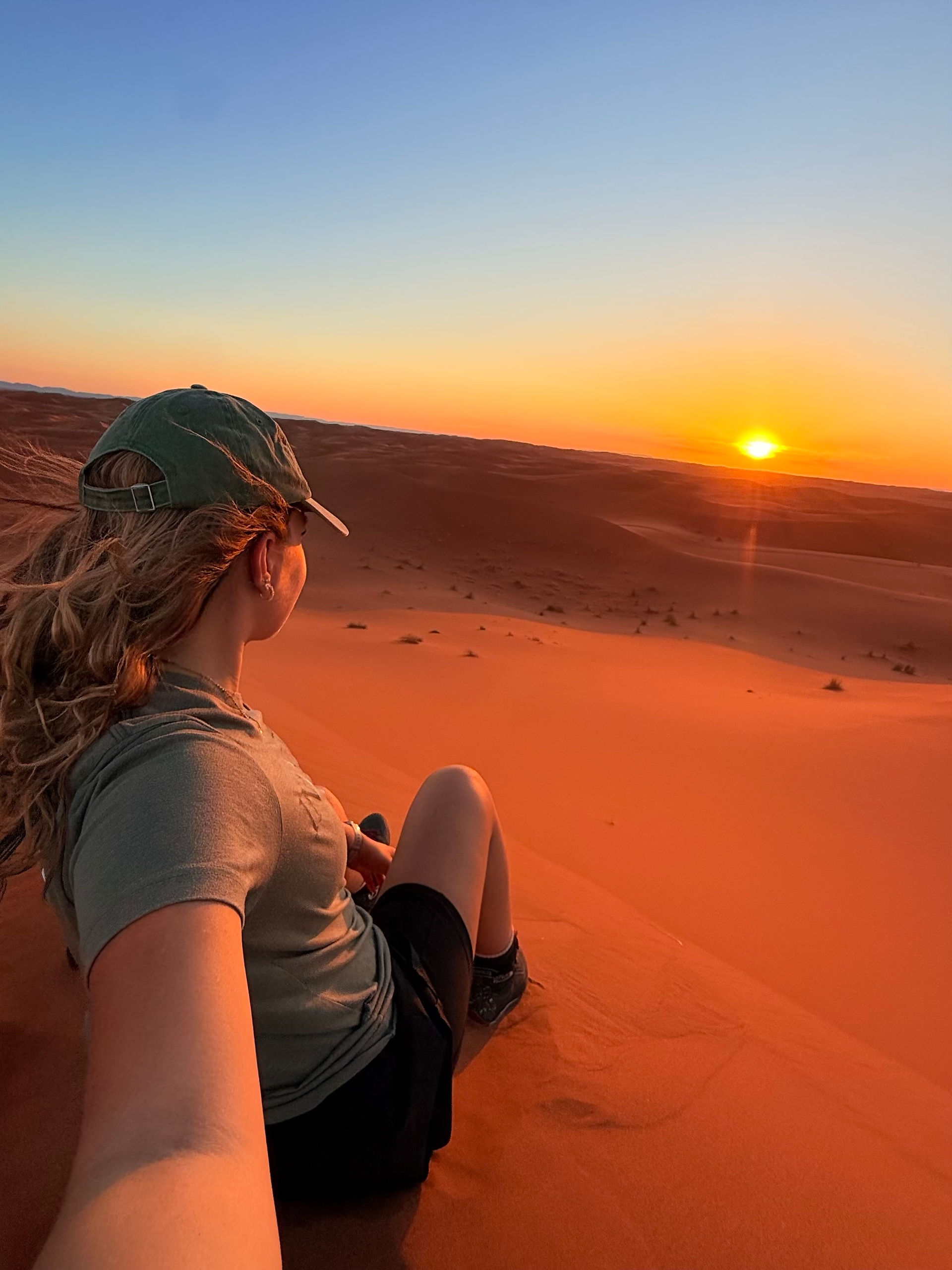
Further south the environment begins to change again as the expedition moves toward the Sahara Desert. Here the land opens into wide desert plains, rocky hamada and eventually sand dunes that stretch toward the horizon.
Camping in the desert provides one of the most memorable parts of the journey, with clear skies, silence and vast landscapes that feel completely removed from the outside world.

Why This Expedition Is Unique
Most trekking trips in Morocco focus on a single destination such as Mount Toubkal or the valleys of the High Atlas. The Atlas to Sahara expedition takes a very different approach.
Instead of staying within one mountain range, the journey crosses several distinct environments across southern Morocco. Travellers move from volcanic mountains to historic valleys and eventually into the Sahara before returning north through a different section of the Atlas.
A key highlight of the expedition is the ascent of Mount Siroua, the highest peak in the Anti-Atlas. Rising above a vast volcanic landscape, the summit offers wide views across the mountains and toward the desert beyond.
This creates a far more varied expedition experience. Within a single journey it is possible to experience:
• Volcanic mountain landscapes of the Anti-Atlas
• The summit of Jebel Siroua, the highest peak in the Anti-Atlas
• Remote trekking routes through the Siroua massif
• Traditional Berber villages and ancient mule trails
• Palm-filled valleys along the historic Draa River
• Desert plains and dunes on the edge of the Sahara
• Mountain terrain again in the Central High Atlas
Few expeditions in Morocco combine this range of landscapes in one continuous journey.



A Different Way to Experience Morocco
Most travellers visiting Morocco either explore the Atlas Mountains or take a short trip into the Sahara Desert. Rarely do journeys connect these environments in a way that allows the full transition between them to be experienced properly.
Crossing from the volcanic landscapes of the Anti-Atlas into the palm valleys of the Draa and eventually the open desert provides a much deeper understanding of southern Morocco. The terrain, climate and culture change gradually as the expedition moves south, revealing how closely these landscapes are connected.
For those interested in expedition-style travel rather than short tours, journeys like this offer a far more immersive way to explore the country.
How the Journey Works
The expedition begins near Agadir, on Morocco’s Atlantic coast, before travelling inland toward the mountains of southern Morocco. From the coast the landscape quickly begins to change as the route climbs into the Anti-Atlas, a rugged volcanic range that forms the first stage of the journey.
Here the expedition explores the remote terrain around the Siroua massif, an extinct volcano rising above wide plateaus and quiet mountain valleys. Trekking through this region provides the first real sense of the remoteness that defines southern Morocco, with traditional Berber villages scattered across the landscape and long mule trails linking isolated communities.
From the mountains the journey continues south toward the Draa Valley, one of Morocco’s historic caravan corridors. This vast valley stretches for hundreds of kilometres and is lined with palm groves, kasbahs and small agricultural settlements supported by the waters of the Draa River.
As the expedition moves further south the environment gradually shifts again. The fertile valley floor gives way to open desert landscapes as the route approaches the Sahara, where wide plains and sand dunes replace the mountain terrain of the Atlas.
After exploring the desert landscapes and spending nights under the desert sky, the expedition turns north once more, travelling back through the mountains via the Central High Atlas before returning toward the northern Atlas region.
This journey across southern Morocco allows travellers to experience a remarkable transition between volcanic mountains, fertile valleys and desert environments all within a single expedition.

Expedition Support and Logistics
Although sections of the journey involve trekking through mountains and valleys, the expedition is fully supported by 4WD vehicles throughout the route.
These support vehicles carry expedition equipment, supplies and camping gear while allowing the route to move efficiently between the different regions of southern Morocco.
In many parts of the Anti-Atlas and Sahara, these desert tracks are the only practical way to travel between remote valleys and mountain passes. Vehicle support also allows the expedition to remain flexible, adapting routes where necessary while maintaining the overall journey across the mountains and desert.
This combination of trekking and supported travel allows the expedition to explore a far greater range of landscapes than would be possible on foot alone.


Following the Historic Caravan Routes
For centuries the valleys and passes of southern Morocco formed part of the trade routes that connected the Atlas Mountains with the Sahara and the markets of North Africa.
Travelling through these landscapes today still reveals traces of that history. Mule paths link remote villages, old kasbahs overlook the palm groves of the Draa Valley, and desert tracks lead toward the same horizons once crossed by caravans moving between the mountains and the desert.
Expeditions that follow these routes allow travellers to experience this geography in the same way it has been travelled for generations slowly, across mountains, valleys and desert landscapes.
Atlas to Sahara with Wild Axis Expeditions
Wild Axis Expeditions runs small-group Atlas to Sahara journeys designed for travellers who want to explore the remote landscapes of southern Morocco properly.
Our expeditions cross the Anti-Atlas, the Draa Valley and the Sahara before returning through the Central High Atlas, combining trekking, remote travel and cultural encounters along the way.
By keeping group sizes small and working with experienced local guides, the journey remains immersive, flexible and focused on exploration rather than mass tourism.
For those looking to experience Morocco beyond the standard trekking routes, this expedition offers a rare opportunity to travel through some of the most varied landscapes in North Africa.
Explore the Atlas to Sahara Expedition to learn more about the route and upcoming departures.


Comments